Showing posts with label self publishing. Show all posts

Saturday, March 18, 2023

My Writing Software/ Resource Collection

Writing the novel is the easy part. It's the fun part. I'd say "it's the free part," but it's really not. 

I am on the cusp of beginning a new writing venture with a new pen name, and with that probably comes a new newsletter and new review campaigns. So here I am listing all my options, and some things that were once free are now charging nominal fees (like $10/month), and that got me thinking about how all the little things just start adding up. While it looks like I'll be putting out this book for relatively little money invested, I can't discount all I've already invested to make this a success. So I made this list of software and resources that's I've invested in over the years to help with my self-publishing career.

Writing/ Editing

  • MS Word
  • MS Excel (for plotting, but also scheduling, book keeping, and organizing)
  • Plottr (as a pantser, I'm shocked how much I love this)
  • Google Docs (free)
  • Scrivener (this was not the program for me)
  • Grammarly (free version)

Cover Art

  • Gimp (free)
  • Shutterstock (subscription or pay per download)

Layout

  • Vellum (so easy)
  • Calibre (free)

Marketing

  • K-lytics (subscription or pay per report)
  • Publisher Rocket 
  • KD Spy
  • Kindletrends Also Bought Tool (free)
  • Instant Data Scraper (free)
  • Author Ad School
  • Story Origin (previously free, now subscription)
  • Booksprout (previously free, now subscription)
  • Book Sirens (pay per campaign)
  • Mail Chimp (free if under 1000 subscribers)
  • Doteasy (subscription)

Ads and Promos

  • For paid advertising: AMS Ads, Facebook Ads, Book Bub Ads
  • For Promos: Too many to list.

Paid Pros

I have enlisted the help of industry professionals in a number of areas. Some areas, I have learned to take over on my own, but when you're starting out, it never hurts to use and learn from pros.
  • Beta Reading
  • Editing
  • Cover art
  • Layout/ Formatting
  • Blurb writing
  • Ad hook writing
  • Social media blasting (do not recommend)

Thursday, September 1, 2022

Amp Squad and the Taking On of Labels


Over the past ten years, I’ve accumulated a few LGBTQIA labels - Asexual, Aromantic, Agender… I remember a time when the A stood for ‘ally,’ and I still encounter arguments on the internet about it meaning any and all of my labels. In more recent language, the list stops at Q… which used to stand for ‘questioning,’ but is now generally listed as ‘queer.’ According to some, ‘queer’ being an umbrella term for nonbinary and gender-queer identities, but depending who you talk to, the umbrella could be even bigger. There really can’t be one list that defines all sexual/gender identities because there are so many, and while some might try to use LGBTQIA+ and queer as synonyms, not everyone is comfortable with the queer label.

On the one hand, it’s just easier to say that I’m queer than to explain my assorted labels. It’s easier to say that I’m a queer sci-fi writer and that I write queer characters. Although the word was one used as a slur, language evolves, and (some) modern Pride movements have reclaimed the word, and use it as a positive affirmation. I’m part of a Queer Sci-fi community, and have grown accustomed to calling myself a queer sci-fi author who writes queer characters. Also, given how much in the minority my particular identities are, sometimes it’s just easier to say queer. It simplifies the conversation.


Last year, I wrote about my journey to accepting the trans label, because technically agender falls under trans, whether I feel trans or not. And the thing about labels is that they are personal. You don’t have to accept a label just because someone else thinks you fit in that box. (I wrote a screenplay about this a few years ago.) Part of being queer is realizing the labels you were born with (or the ones assumed to be default) aren’t the right ones for you.


Which brings me to Amp Squad. I debated with myself over whether to use this title, because in Ship Whisperer, the Amps didn’t like being called ‘Amp.’ Tabitha would use it for herself, but respected that others like her were more sensitive about the label, which was shorthand for “amputee.” Three of the five amputees did not advertise their missing limbs, and in the story, I deliberately did not address which limb(s) they were missing.


In Amp Squad, I develop a new terminology for those with super powers: Amplified Power Individuals. The characters appreciate the API terminology, because it shifts the focus from their missing limbs to their growing powers. It also gives the term ‘Amp’ an alternate meaning that they can latch onto with pride. The reclaiming of the word is a slow process, explored internally by the team as they test the label. The bigger battle for them it reminding the military that APIs are not soldiers. They are civilians… except for the main character, Tabitha, whose loyalty to the military is constantly challenged by their treatment of the APIs.


Labels are tools. They are a shorthand to describe something complex with a single word. But words have power — to unite, to divide. Take your word power, and use it for good.


***

PRE-ORDER YOUR COPY OF AMP SQUAD TODAY!


Thursday, August 18, 2022

Unsolicited Wisdom From My 5-Year Self-Publishing Experience

 “You can make a wish, but then you have to do the wish. It doesn’t just happen.” -some kid

September 8, 2022 is my fifth anniversary of my being a self-published author. I did not plan to release Amp Squad on the anniversary; it just sort of happened to be a convenient day based on when all the pieces came into alignment.


In my original 5-year plan (I had a snazzy spreadsheet), I had planned to release 9 books in these 5 years, which seemed do-able, since I had first drafts of all of them. To my surprise, the muse would not be silenced, and more novels cropped up in between. Amp Squad brings my total to 13!


I have learned a great deal about self-publishing in the past 5 years (6 years, actually, because I decided to head down this road in 2016, about a year before the first release). For any of you thinking about self-publishing, here’s my unsolicited wisdom.


1. Self-publishing is not the fallback plan for people who can’t find a publisher. A lot of people put out a few queries to traditional publishers, get frustrated, and expect to self-publish without realizing how massive an undertaking it is. I made a previous post about the many hats of a self-published author. It’s a lot. You are a publisher using a single person’s work (yours) to support your entire company! It’s not the easy road. It’s just another road.


2. You do not have to publish a book a month to be successful. A lot of us are supporting our self-published author careers with a day job, and one book a year is a perfectly acceptable rate. Now that I’ve finished my New Dawn series, I don’t have a queue of first drafts anymore, so producing multiple books per year is both a time commitment and a challenge. I love writing, but part of what keeps it fresh is that I do other things and absorb other art. 


3. Marketing is hard. By far, the best thing I’ve done is align myself with author communities where advice is freely exchanged, and there’s no shame in asking a question that has been answered a hundred times because now it applies to you. My favorites are: Author Ad School, /r/selfpublish, /r/scifiwriting, and Facebook Indie Cover Project. These people *know* things, because they’re on this journey, too! Also, whenever there’s a private author community associated with a book or tool, join it. Buy at least one K-lytics report for your target genre, just so you understand the breadth of what there is to know. 


4. Hiring editors, cover artists, or anyone else to help you in your journey is a process. Do not be afraid to interview, get quotes, and ask questions. You have to work with these people, and you are the project manager. Make sure everyone knows the schedule, budget, and expectations. 


5. Your friends and family are not your target audience. Obviously, those that are fans of your genre and buy multiple books like yours are your target audience, but generally speaking, most are just buying your book to be supportive of you as a human being. But don’t take it personally if they’re not blasting about you on social media, fanning about your characters, and pre-ordering every book you write. Market to readers, discuss writing with writer groups, and let your friends and family be the ones outside who fill you with conversation and ideas, and become fuel for your art. 


I love writing and look forward to many more years of creating art. Happy reading, and be sure to check out Amp Squad! It's currently available for pre-order.


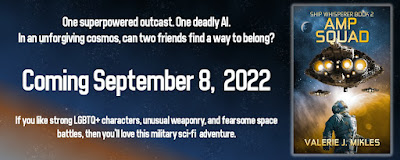
Amp Squad Coming September 8


Monday, October 4, 2021

Nothing to Prove - From Apathy to Agender

 Last year, I released a book called The Qinali Virus, featuring an asexual aromantic character, because I wanted to see people like me represented in fiction. In this future society, gender isn’t assumed or assigned at birth. Children use neutral pronouns unless they express a desire to be otherwise. In one of the scenes, my main character Amber says she wishes she’d kept her neutral pronouns. It’s a passing thought for her, but this character was very much a reflection of me and I started looking at my own relationship with my gender.

The Qinali Virus - novel cover

I’ve been “cis-apathetic” for much of my life. I never felt like a girl, but I also knew for sure I wasn’t a boy. The nuance of nonbinary identity wasn’t part of my vocabulary, so apathy set in. I dissociated from my body. I remember feeling very out of place as a woman in science, because ‘woman’ wasn’t part of my identity. It was just a happenstance.


After writing The Qinali Virus, I figured out I was agender. I was very insistent on that label, because other labels seemed to imply the existence of gender, and I have none. It took time to accept that “not cisgender” means trans, because I didn’t feel trans either. I think it’s partly because society trains us to think and recognize trans along a binary. If you’re not girl, you must transition to boy. So it’s very confusing for the nonbinary, genderqueer, gender fluid, agender, and everyone else whose resting point is not on the binary or even on the so-called spectrum. I also felt that if I were going to be trans, then I had to do something to prove it, like change my name and pronouns. 


Which brings me to Ship Whisperer – the story of a nonbinary explorer who discovers she has the ability to talk to spaceships. It’s mentioned a few times that she is nonbinary, and early beta-readers even commented that it was easy to forget, because she’s not using neutral pronouns. But you know what? That’s just fine. She doesn’t have to change her pronouns to prove she fits the category. The phases she went through to find her pronouns aren’t part of this book, but she found them.


I’m not a woman. I often think of changing my name and my pronouns, but whether I do or not, it won’t prove or disprove my trans-ness. I’m agender, and saying it is enough.


Ship Whisperer comes out October 14! Pre-order now!


Monday, September 13, 2021

Singing and Editing - My Playlist for Ship Whisperer

Earworms that interrupt my editing


In Ship Whisperer, the character has a song that she hums, that helps calm her thoughts and connect her to her psychic ability. What is this song? Well, it hasn’t been written yet.

I have this pet peeve when I’m reading or watching far-future sci-fi—characters that sing songs older than I am, as if a new classic will not have been written in the next however many centuries. It just bothers me.

So when it came to this story, my choices were (1) annoy the crap out of myself by picking an old, familiar song in the public domain, or (2) write a new song. Well, let me tell you, it is no easy task to write a song when it’s the only song in the universe. There’s too much pressure to have the perfect message that encapsulates the novel.

Now there’s an artist I’ve been listening to recently, and in more than one of their songs, there’s a hummed verse or a chorus of “la la la…” I can’t explain why, but it makes me happy. So I thought “what if there are no lyrics to my song? What if it’s a melody of la la-la la-la?”

My brain couldn’t get behind that either. I dug through some of my old poetry and found one piece called Kinesthesis that seemed like it might work, and I considered using those lyrics and making a song. But it was TOO apropos to the bigger picture of the story, and it didn’t really capture the simplicity of the lullaby I wanted to create. Clearly, I fell into the trap of overthinking this. And so I leave it to my dear readers to find the tune.

But in the meantime, here are some songs that were running through my head while I was editing and proof reading. I usually write in silence, and to be fair, I was also editing and proof-reading in silence. It’s just really loud in my head.

(Links are to versions on Bandcamp so you can support these indie artists.)

- Tiny Paper Elephant by The Doubleclicks https://thedoubleclicks.bandcamp.com/track/tiny-paper-elephant

- A Simple Song (in Troubled Times) by Sunday Comes Afterwards https://sundaycomesafterwards.bandcamp.com/track/a-simple-song-in-troubled-times

- The Horse is a Pain by Sunday Comes Afterwards https://sundaycomesafterwards.bandcamp.com/track/the-horse-is-a-pain

- Space Shanty by Misbehavin’ Maidens https://misbehavinmaidens.bandcamp.com/track/space-shanty

- The Alligators by The PDX Broadsides https://thepdxbroadsides.bandcamp.com/track/the-alligators

- Buffalo by The PDX Broadsides https://thepdxbroadsides.bandcamp.com/track/buffalo

- Klingon by The Library Bards https://librarybards.bandcamp.com/track/klingon

- Sky Full of Phoenix by Rhiannon’s Lark https://rhiannonslark.bandcamp.com/track/sky-full-of-phoenix

- Han and Leia by The Chromatics https://thechromatics1.bandcamp.com/track/han-and-leia

- A Lullaby for Mr. Bear by The Doubleclicks https://thedoubleclicks.bandcamp.com/track/a-lullaby-for-mr-bear-adult-version

I’ve actually done covers of The Alligators and A Lullaby for Mr. Bear on my youtube channel. I’m learning Han and Leia for a future video. Yes, I enjoy musical comedy. No, Ship Whisperer is not a comedy. It’s called balance.

---

Ship Whisperer comes out October 14, 2021. If you'd like to join my launch team as an Advanced Reviewer, please check out my Book Sprout ARC page


Tuesday, September 7, 2021

Power of a Prompt - The Inspiration for Ship Whisperer

“Where do you get  your ideas?” 

It’s a common question, and the answers are as varied as the writers. Did you know that a bonsai tree is genetically identical to the full-sized tree grown in nature? It’s the same seed, but nurtured differently. How many Cinderella stories do you know? Or Batmans? Your seed idea doesn’t have to be original. Your execution and your voice are what make your story unique.

For my new story, Ship Whisperer, it started with a prompt. It was a chilly October. (Or maybe not. I don’t remember the weather.) My writing critique group was meeting at the local Wegmans Café. I had just published my first novel, and my second was slated for rapid release a few weeks down the line. I was knee-deep in writing my series. (I had a five year plan.) At the end of the critique session, we had some time, so our organizer put forth a writing prompt. We had three words and fifteen minutes to incorporate those words into a story. Those words were: blue, Hawaiian shirt, and dog. 


These words don’t really scream “sci-fi story” do they? They didn’t to me, either. I could have written something contemporary, but I wanted to practice my brand of sci-fi. So I created a color-sensitive telepath who used an AI dog to communicate with her crew. The concept of my ship-whisperer had formed. None of the prompt elements survived to the final novel, but from them, I had a character that intrigued me and I wanted to write more of.

Using the character from the writing prompt, I then wrote a short story for my writing group to critique. That was when the military aspect came out, the alien war, and the idea of psychic imprints. The general feedback was that the idea was too big to be contained in a short story. Although, that may have been reader bias. Hardcore sci-fi readers can fill in a lot of blanks from established tropes. But I loved my characters and wanted to play more with them, so I added the story to my “To Be Written Pile.”

I poked at it between other stories, testing my thoughts, seeing what developed. Letting ideas percolate is all part of the process. Then I draft, I workshop, I get input from beta-readers and ideas evolve further. The tree doesn’t resemble the seed.

What would you do with that seed? What would you create? Take fifteen minutes and just write. See what you come up with. Stick with your favorite genre. Practice. Not every prompt inspires a novel, but it’s a fine place to start.

Ship Whisperer hits the shelves October 2021

Subscribe at http://www.valeriejmikles.com for updates

A military sci-fi space opera about a nonbinary person who develops an ability to talk to an alien spaceship.


Tuesday, November 10, 2020

Premonition (Excerpt)


Premonition - The New Dawn Book 7

Counting down to the release of Premonition, the exciting new addition to The New Dawn series.


*~*

Seeing the future is not the same as saving it.

When the first premonition hits, Amanda thinks it’s a hallucination. She doesn’t have psychic power; she echoes the powers of others. No one on the ship has that power, but the Confluence stones they acquired on Terrana seems to have extended her range. Her sudden ability to see the future has done little to help her crew prepare.

Led off course, their ship finds Nola, a peaceful farming town celebrating their annual Festival. The moment she enters the city, Amanda feels more echoes of power than she can control.

Overwhelmed by both the Festival and the spirit power in the city, Amanda begins a hunt for a powerful human-spirit half-breed that can help her, and finds herself at the center of the city’s battle to purge spirit-kind from their midst.

Can Amanda’s borrowed powers give the crew the edge the need?

Find out in this epic sci-fi thriller, because knowing the future is only half the battle.

*~*

EXCERPT:

The streets of Nola were bustling, the music rising, the vibrant multi-colored banners glittering in the evening light. The air smelled of perfumes, pheromones, and alcohol, the scent getting thicker as Festival-time approached. Prince Corin Toulane hated Festival.

“Corin, you look like a walking tapestry in these robes. I don’t think this style will catch on,” his friend Judith said. She greeted him by the Palace gate with a friendly swat on the arm, causing the beads on his sleeve to rattle. As Prince of Textiles, he enjoyed watching the fashion trends he created sweep through the city, but his Festival robe was one-of-a-kind. After his first Festival, he went around collecting the fallen beads and gems, and decided to make a robe that captured the spirit of the event. He’d been adding to it for two years now. The left sleeve was purple and gold, the right green and silver. The reds went down the back, creating an ombre effect. 

“I’m hoping it makes me unapproachable,” he grinned, kissing her on the cheek. He and Judith had been friends since childhood. She had come of age for Festival a year before him and seemed to love the energy of it. Her purple, blue, and pink robe was shorter than his, cinched at the waist, and adorned with rhinestones and sapphires. The spray-on dyes in her hair matched the three colors of the dress, creating a marble pattern when swept into an up-do.

“I’m taking you to a new venue opened by the Prince of Metallurgy. It’s smaller. More intimate,” she said, clasping both her hands around his. 

“I’m following you,” he said.  

When she smiled, the Festival lights caught the glitter on her lips. Before he came of age, he used to help his father plan for Festival. He loved choosing the color themes and designs. Then he’d attended one. The city-wide party was little more than an attempt to bolster the population through drunken copulation. The realization had killed the magic of the event. Now he dreaded seeing the Festival banners fly. He stuck close to Judith and prayed for the night to end quickly.

“I had to make reservations two weeks in advance. Final selection was by lottery.” 

“Lottery,” Corin huffed. “They see the name Toulane and there’s nothing random about that selection.”

As the son of the town magistrates, Corin was accustomed to selective treatment, especially for solicitations to Festival venues. Corin had trained hard to achieve his rank, but his appointment to the office of Prince meant next to nothing, because he lived in his parents’ shadows.

“Small venue,” she said. “No one is there for show. No one is making fake conversation.”

“It’s fake as long as it’s Festival,” he said, pulling a bottle from his side pocket and taking a sip. He kept a bottle of non-fermented pomegranate juice handy because he didn’t like losing his mind to the aphrodisiac-laced Festival wine. To others, it looked like he was drinking.

“You know who gets to skip Festival?” she asked. “Your sister. Get me pregnant and—”

“You know who doesn’t get to skip? My sister’s husband,” Corin interrupted. “If I get you pregnant again, who am I going to spend my night with next Festival? I couldn’t get through this without you.”

Judith giggled and kissed the back of his hand, leaving a trace of glitter on his skin. He felt their inevitable future—one day, he’d have children with her. There was no one else he loved. And he wished he loved her as more than a friend.

“Try this,” Judith said, producing a pinky-sized purple vial from her cleavage. “It’s Kan. It’s a new one.”

Corin sighed. Festival drugs were called recreational, but they were far more than that. They didn’t lower inhibition between couples; they fueled lust. Last year, he and Judith had tried Etna, and Corin couldn’t remember anything after that first drop. Judith got pregnant and then miscarried a few weeks later. The loss was devastating, and no amount of Etna could make him forget that pain.

“You don’t have to,” she said, tucking the vial away. She slid her hand up the sleeve of his robe to rub his arm.

“What’s it do?” he asked.

“No fertility enhancers, pheromones, or mood-shifters. It heightens your sense of touch,” she grinned, her hand sliding farther into his robe and across his back. Festival robes were designed to double as a covering in the event of public sex.

“Sniff, mix, drop?” he asked, checking her eyes for permission before sliding his fingers down the front of her dress for the vial.

“Drop,” she said.

Corin unscrewed the lid and let a single drop fall on his tongue. A tingle spread through his body, the warmth pooling where Judith’s hand touched his skin. But it didn’t set his body aflame or make him feel out of control. He felt content and comfortable.

“I’ll have some more of that,” he decided, unscrewing the cap again.

“At the party,” Judith promised, taking the vial from him and tucking it away again. “I’m saving a drop for Alyssa.”

Corin pressed his lips together. Alyssa had joined them at Festival before, but she was interested in Judith, not Corin. At Festival, same-sex coupling was taboo, but Alyssa and Judith could get away with it as long as he was there. Corin would rather the women kiss each other than him, so he didn’t complain.

Judith kissed his cheek, and he shivered at the heightened sensation. The Kan didn’t just amplify physical sensation, it amplified his hesitance. His nostrils burned, too.

“Do you smell that?” he asked, pushing her hand out from under his robe.

“Yes,” Judith whispered, her eyes darting about. Then she pointed to a plume of black smoke rising into the dome not half a block away. “Fire!”

Corin swore and ran toward the smoke. Flames rose from the third story of a metal and wood manor. Someone inside threw themselves against the window but was unable to break the moon-slate reinforced glass.

“Call for help,” Corin told Judith, searching for a way to get to the upper levels. There was a faded outline where the escape ladder should have been bolted on.

“Who? Everyone is at Festival!” Judith cried.

“Anyone can haul water!” Corin said. This was the venue he and Judith had been heading toward. They would have been trapped inside!

A uniformed officer came around the building, his jacket pulled up to shield his nose and mouth from the smoke. Corin recognized the him from the Palace.

“Officer Belgard!” he called.

Belgard’s eyes widened and he dropped the jacket, looking from Corin to the building. “How did you get out?” he snapped.

“I was never in,” Corin said. “The escape ladder is gone from this side. Is there one around back?”

Belgard looked up at the building, his cheeks twitching, his expression unreadable. “No. They’ll burn,” he said, seeming disconnected from the tragedy of his words.

“We need a ladder—”

“We will do nothing. The venue is filled with Fotri. Good riddance,” Belgard spat, the numbness giving way to vitriol. 

Corin’s jaw dropped, his blood boiling. Fotri was a name for people who chose same sex partners. People like Alyssa and Judith. Even Corin’s mother expressed anti-Fotri sentiments.

Suddenly, Corin felt a club bash him across the shoulders and he fell to his knees, stunned. Belgard grabbed him by the robe, dragging him toward the burning building. 

“What are you doing?” Corin cried.

“You wanted a way in. Burn with your Fotri friends,” Belgard growled. 

“But I’m not—” Corin began. Even if he were Fotri, that didn’t justify Belgard throwing him into a burning building! Pulling a canister from his robes, he sprayed the Festival drug in Belgard’s face, disorienting the man.

The people trying to escape the upper level could not crack the glass. Corin needed a ladder and a hammer. If he were in the textile district, he’d know exactly where to go. 

“Judith!” Corin called.

Someone jumped on his back and clamped a hand over his mouth, hissing at him to be quiet.

“It’s a good thing you were late,” Alyssa growled, sliding off of him. Her exposed skin was smeared with soot. “Come on!” she said, dragging him away from the fire. She hopped on one leg, favoring an injured foot.

“What? No!” Corin cried, jerking away from her. He quickly shrugged out of his robe and wrapped it around her bare shoulders. “How did you get out?”

“I was on the balcony. Suddenly, all the locks clicked, and I couldn’t get back in,” Alyssa said. “Festival robes do not make reliable escape ropes, but at least... there’s no way in, Corin.”

“We have to try. We can’t leave them to die,” Corin stammered, pointing to the sealed building. The smoke had to be getting out somehow.

“A service officer just killed a house full of Fotri,” Alyssa hissed. “There was no random lottery, Corin. That fire was meant for us.”

She sprayed something in his face, stunning him the way he’d stunned Belgard, then she shoved a pill in his mouth and forced him to swallow. She was getting him out whether he wanted to go or not.

*~*

Premonition is currently available for pre-order. Order the whole series today!

Monday, September 21, 2020

Self-Employee of the Month!


 I hate headshots. I know some authors like to put them on their book covers (or in their books). I know some readers like to see them. I think it's the weirdest thing. Humans are an inscrutable race. Nevertheless, every now and then I set up the green screen and the lights, I put on makeup and think about which shirt I wouldn't mind seeing the collar one in a photo, and I take a ton of pictures.

These are some that did not get selected for professional use. Now, I get to use them for entertainment purposes.

And calling back to my previous post about the many hats of a self-publisher, every one of these employees works in a different department, and they are all deserving of an award.

The awards are as follows:

  • January - Valerie the Ad Content Writer, for composition and editing of book blurbs
  • February - Valerie the Tax Accountant, for completion of business taxes
  • March - Valerie the Market Researcher, for blog promotion reconnaissance 
  • April - Valerie the Publicist, for her amazing efforts in hosting an online book launch
  • May - Valerie in Human Resources, for negotiating a contract with editing services
  • June - Valerie the Novelist, for great efforts in writing alien stories
  • July - Valerie the Cover Designer, for tireless efforts in designing seven book covers
  • August - Valerie in Advertising, for creating promos that doubled our previous month's page reads
  • September - Valerie in Layout Editing, for efforts in preparing Book 7 for publication

Seriously, indie authors. Congratulate yourself for the volume and variety of work you do. Celebrate a little bit. I can't wait to see what other awards I get this year!

This dose of happiness was inspired by the Beardo "Self Employee of the Month" comic book. If you need a slice of life comic, check him out

Wednesday, August 5, 2020

My Writing Method: From idea to first draft: A plotting method for discovery writers

How do you get a story from your brain to the paper?

For me, I've always been a discovery writer. Most of my stories start with a name and a single-word concept. A person looks out a window and sees... the world unfolds before me, but one piece at a time. It's amazing how coherent and full it seems in the end without my even trying to work out the details. When I read through later, I see all these nuggets of cool ideas that I can develop more in the edits, but those cool ideas don't come to me if I sit down to plot them. They reveal themselves to me once I write the story.


This method can be slow, and lead to hundreds of pages worth of deleted scenes that don't make it into the final novel. (I keep all those scenes, in case I can use them later, but there are definitely several novels worth of extra.) 

As I've grown, though, I have learned to streamline my discovery-writing style, and turn it into a process that helps me get closer to my goals on the first draft, without leaving me with so many deleted scenes. While plotting is involved, I do not consider myself a plotter, because much of the world-building and development is still done via discovery writing.

Here's the method I've used to get from an idea to a first draft for my last three works-in-progress.

Tools: whiteboards, legal pad, and a laptop. I choose the tool based on how my brain is working that day.

Pro Tip: Don't get so hung up on a method that you can't take advantage of how your brain is working that day.

Step 1: Concept Sketch
  • concept, cool notion, inspiration
  • thoughts about the protagonist
  • ideas about the environment 
  • ideas about the major conflict 
  • any super-cool nugget that I'm worried I'll forget when I get to the nitty gritty 
This may be only a few disjointed paragraphs filling half a page or so. I usually keep this part short, and am done in 20 minutes. I can add to this as more ideas occur to me. This list is the holding place for cool ideas or world building I'm worried I'll forget.

E.g., for my current work in progress, I set out to write a YA novella that did not feature a young super-genius orphan who had to win the guy and save the world.

Notion: Cyber-bugs
Protagonist: Asexual, tech hobbyist (has a cyber-beetle), parents are alive/supportive
Environment: Space station. There are aliens

I honestly do not need much to get started, and as I go through the other steps, I sometimes jump pack to this list and add bits of exposition (like the history of how the humans and aliens got to be on this space station) that will need to be folded in. It's easier to write exposition outside the story, so then I can streamline and feed pieces into the story in bite-sized pieces.

Step 2: Big Picture Outline

Next, I think of the big picture outline. For this, I like to use a white board. I think of a loosely 5-act structure. Where do I want to be when? I write down the numbers 1-5, then I write a sentence fragment (usually less than 10 words) about what that segment of the book is about.

Here's a rough and terrible sample plot:
  1. Someone gets sick 
  2. More people get sick, realize pandemic
  3. Sickness only targets enemies of villain. It's a weapon! 
  4. Find allies, seek cure. 
  5. Blow up space station
If I actually wanted to write the story, there'd be references to some of the things I wrote in step 1, but this is just an example. Thinking about it more deeply than this can actually hinder my discovery-writing process. 

If I were truly discovery writing, I might just start with the knowledge that Tina is in the hospital with the flu, and parts 3-5 wouldn't even be on my radar yet. So I tend not to worry if things are vague, because I've still thought more about my ending than normal, and it's throwing off my game.

Step 3: Implant Seed Scenes

Once I have those key points in place, I take any seed scenes I've sketched out and drop them into their approximate locations. 

Seed scenes are scene fragments and plot bunnies that sit in a file so that I can percolate characters and worlds before I sit down to decide what their story is. They may take place at random points in the story, and are easily jossed when certain features of the world get fleshed out and changed. When I have zero seed scenes, the first draft is pretty awful. (That's okay. That's what editing is for.) When I have 5k words or more of seed scenes, I'm much more relaxed. For some of my novels, I have upwards of 20k in seed scenes already written.

Pro Tip: Keep your seed scenes organized and title them well so that you can find them later. I have a google drive folder. 

Step 4: Discovery Sketch

Once things are sort of in place, I plow through a chapter-by-chapter outline, sketching the scene action/dialog, and writing a one sentence descriptor for what else needs to happen if I'm still a little fuzzy. 


Scene sketching for me allows me to tap my discovery-writing instincts, while omitting excessive detail and keeping the pace of an outline. Unlike the creation of the seed scenes, these scenes are generated chronologically. (Or as they appear in the book, if the book is not chronological.) I learn more about the characters and relationships, and can exploit that when I start drafting. There are a lot of gaps, and things will definitely evolve, but this helps set up flows and motivations, and ensures I have a solid beginning, middle, and end before I get too hung up on prose.

For my current work in progress (the YA novella), this took about 2 days, and I had a 15k word sketch. For a full-length novella, this might take 3-5 days. 

Since scene-sketching is very fun for me, I can devote many hours a day to this and still be super-energized. I actually have to schedule other activities, so I remember to get up and walk around. This is partly why I get so confused when people ask about writer's block. For me, writing is a very difficult thing to *stop* doing.

Step 4: The First Draft
sketch of space station
Sketch of a space station
Once the outline is done, I save the file under a new name. Exposition that's in the outline will not be in the prose of the chapter, but it's good to have later as a reference. Also, saving your file under multiple names can help later.

In the new file, I start at Chapter 1 and write all the scenes, getting into prose mode. I might skip forward to leave a note, but not back. I'll use the review/comment feature if I need to make a note about changing something I've already done. 

I start drawing maps of locations, and filling in some world building, using my whiteboards so I have the information at a glance as I write. I make sure I keep copies in a notebook. Visual and tactile notes work well for me here. 


 New chapters get added as things reveal themselves. I constantly have to remind myself "first draft, keep going, just get it out." 

I'm now about one week, and I'm at 40k words with two chapters left to go on the first draft. I usually write 80-100k novels, so my brain is very confused about how short it is, but it is in keeping with my goal for this story.

And that's how I get an idea from my brain into a first draft.

Wednesday, July 15, 2020

The Many Hats of a Self-Published Author

There are many hats, and they all say something about you
A lot of us, when we start the road to self-publishing, know a lot about the craft of writing, but we don't realize just how many different hats we'll have to wear (or how many different types of experts we'll need to hire) to realize our dream. Below is a list of some of the jobs involved.

I made this because a lot of us, when we're working on a single step in the process, get frustrated that it's not straight forward and we can't learn it in a weekend. For example, I recently re-did the book covers for my series. I thought I could do it in a weekend or a few days. For six books. I eventually realized that when I originally hired my cover artist, I gave him a single stock photo and asked for text/color work around it. He probably spent an hour or three, and we had some back and forth over the days to get in all the tweaks. I was trying to create art from multiple stock photos (something my artist would have charged four times as much to do). I was learning how to place text, do color corrections, make light and shadow elements... I was learning a whole new trade.

A lot of the tasks a self-publisher takes on are new trades, and completely different from their primary skill, which is writing books. These jobs on their own might require a degree or certification, and many years of experience to get good at. There's a reason books about self-publishing can go on for volumes. Let's give ourselves permission to learn, to ask for help, and to take no shame in outsourcing to an expert.

THE MANY HATS OF A SELF-PUBLISHED AUTHOR

Management
  1. Project manager (responsible for overall schedule and budget)
  2. Book keeper (responsible for tracking expenses, sales, royalties, and inventory)
  3. Human resources (responsible for finding services, interviewing and hiring editors, artists, or any outsourced task)
  4. Office manager (responsible for finding best computer, software, ink, etc)
Writing Phase
  1. Author
Editing Phase
  1. Beta-reader 
  2. Editor 
    1. Developmental
    2. Line/ Content
    3. Copy
  3. Proofreader 
Publishing Phase
  1. Blurb / copywriter
  2. Front/back matter content writer
  3. Layout and formatting expert
  4. Cover Artist
  5. Web Designer/ webpage master
  6. Market researcher (responsible for researching keywords, categories, price points, and potential markets)
  7. Distribution guru (responsible for uploading books, covers, blurbs, to various distribution sites, and applying market research)
Marketing Phase
  1. Ad copywriter
  2. Graphic artist (for online ads, physical media like bookmarks, and other swag design)
  3. Video editor (optional)
  4. Market researcher (responsible for finding new outlets)
  5. Ads & promotions manager
  6. Social media/blog content writer
  7. Sales and market analyst (to figure out if your current marketing efforts are profitable)

Events (for those who do live events)
  1. Travel coordinator
  2. Event planner/coordinator
  3. Publicist
  4. Bio writer
  5. Photographer (headshots)