Monday, October 12, 2020

I must be an alien (an asexual's perspective)


I wrote a song!

I didn't know I was ace growing up. All I really understood was that the people on TV who were most like me were not human. They were missing out on the "core of the human experience." But as a sci-fi fan, I was always sort of okay with my alien identity.

I was once doing a twitter Q&A for queer scientists, and I remember saying something about how asexuality defines something I'm not. Sure it's an identity label, but it's a label that has ruled out all other labels in its category. The same with aromantic and agender. It doesn't describe something I feel, but rather the absence of a feeling that seems pervasive in others.

I can honestly say that it was only in the past few years, when I started to embrace nerdy music about fandom, anxiety, cats, dinosaurs, and soda addiction that I started to realize that I share so much more of the human experience than my childhood led me to believe. I can be human. (I'm working on a song about that, too, but music is not my main writing.)

So in the last verse of this song, I talk about all that I am and what defines me as a human being. And if all that isn't enough, then I want to be an alien. So take a listen!


Thursday, October 8, 2020

SALE - Trade Circle is on sale for $0.99


As we're leading up to asexual awareness week, I'm having a sale on my books featuring asexual characters. I wrote in a previous post how writing this book helped me understand my identity. I was so thrilled that one of my reviewers loved the ace character in this book. I hope you love it, too!

Tuesday, October 6, 2020

Discovering my queer identity: I wrote aces before I knew the word...


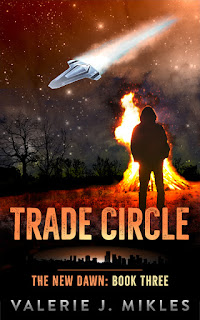
Trade Circle: The New Dawn Book 3
Before I ever took on the label of asexual, I drafted a book called “Trade Circle.” I wrote about a girl whose childhood friend had fallen in love with her, but she didn’t feel that way about him. She had never even thought of him in that way, and she tells him so. When my editor read that line, he asked me “why would she lie.” From his perspective, of course she’d thought of him that way. Of course, she must have considered it. Fortunately, in the time between the draft and the publication, I learned about asexuality, and I could put a name to my character's truth. She wasn't lying. It hadn't occurred to her any more than it had occurred to me. In the final draft of the book, I use the label, so that there is no doubt.

Another example… before I got knee deep into my novel writing, I was writing lots of fanfic. Mostly Firefly, but I have Chuck, Torchwood, Big Bang Theory, and a few others… Not all of it is G-rated, because after writing a few episode-esque Firefly novellas, I learned that adding romance got me more attention and comments. As I had no real experience, I was going mostly on things I could research or learn from other people's writing. (My experience with college boys started making a lot more sense once I learned what non-aces fantasize about.)

Anyway, in the Big Bang Theory, Sheldon made it very clear in the early episodes that he wasn’t interested in relationships. When he finally met up with Amy, it became clear that he was not interested in a physical relationship. It really bothered me (1) that Amy flipped the script and suddenly wanted more from him, and (2) that she kept pressuring him to be physical when he made it clear he didn’t want to. I was very happy when they broke up, because it became clear they were incompatible in this manner. And it made me sad, so I wrote, because I thought she needed to listen and respect him. I didn’t realize I’d head-cannoned him as being like me—being asexual. I’m sad the writers decided not to go that way.

It kind of struck me how important it is to address identity (even lack of identity) in a clear way. People can make their own head canons and deny what you wrote. (Fan pairings in fanfic is enough to prove that.) For me, calling a character asexual isn’t just about identifying what they feel, but in confirming 100% to readers like me that what they feel is real and valid, and they are in fact seeing themselves.

Thursday, October 1, 2020

Guess What? I'm Asexual!

 Asexual Awareness Week is coming soon! Why do I care? Well, because I am asexual. I do not experience sexual attraction. I’m also aromantic, meaning I don’t experience romantic attraction. I discovered these labels when I was 32, and was so relieved that I wrote a story about it. A screenplay, actually. 

You can check out my comedic web series “Aces” about a group of asexual friends surviving in a hyper-sexual world. Check out the whole channel. “Aced It: Human Studies” is one of my favorites. I have a few more scripts in the queue, and I’d love to make more as soon as we’re out of quarantine and can safely gather in groups again.

I started with the screenplay, because realizing you’re asexual can be very isolating. As a novelist, even if I filled my novel with asexual characters, I didn’t think I’d capture the feeling of community in the same way. When I made my films, everyone working there was asexual, knew about asexuality, or learned about asexuality. (The learning was awesome.)


Here it is: Human Studies!


Thursday, September 24, 2020

Watch a government fall! (No, not ours.)


Confluence on sale for $0.99


Tray wanted to stay with his son…


… his crime-boss father-in-law had other plans.


Tray hated spaceships and micro-gravity, but he loved Saskia, and not just because she was a weapons expert and protector. She would have made a good step-mother, and he a good father, if they hadn’t been taken hostage on their 400-year old cargo ship.


Sikorsky wanted power.


Despite his money and his teleportation power, he had no army, and he barely had a plan. But a storm was brewing on Terrana, and Sikorsky planned to seize control. If Tray didn’t help, his family would disappear.


One plan was for mutiny…


… one for a government coup.


It was time to fight back.


You will love this sci-fi adventure, because even when the walls come down around you, your family will be there.


Get it now!

Monday, September 21, 2020

Self-Employee of the Month!


 I hate headshots. I know some authors like to put them on their book covers (or in their books). I know some readers like to see them. I think it's the weirdest thing. Humans are an inscrutable race. Nevertheless, every now and then I set up the green screen and the lights, I put on makeup and think about which shirt I wouldn't mind seeing the collar one in a photo, and I take a ton of pictures.

These are some that did not get selected for professional use. Now, I get to use them for entertainment purposes.

And calling back to my previous post about the many hats of a self-publisher, every one of these employees works in a different department, and they are all deserving of an award.

The awards are as follows:

  • January - Valerie the Ad Content Writer, for composition and editing of book blurbs
  • February - Valerie the Tax Accountant, for completion of business taxes
  • March - Valerie the Market Researcher, for blog promotion reconnaissance 
  • April - Valerie the Publicist, for her amazing efforts in hosting an online book launch
  • May - Valerie in Human Resources, for negotiating a contract with editing services
  • June - Valerie the Novelist, for great efforts in writing alien stories
  • July - Valerie the Cover Designer, for tireless efforts in designing seven book covers
  • August - Valerie in Advertising, for creating promos that doubled our previous month's page reads
  • September - Valerie in Layout Editing, for efforts in preparing Book 7 for publication

Seriously, indie authors. Congratulate yourself for the volume and variety of work you do. Celebrate a little bit. I can't wait to see what other awards I get this year!

This dose of happiness was inspired by the Beardo "Self Employee of the Month" comic book. If you need a slice of life comic, check him out

Wednesday, August 5, 2020

My Writing Method: From idea to first draft: A plotting method for discovery writers

How do you get a story from your brain to the paper?

For me, I've always been a discovery writer. Most of my stories start with a name and a single-word concept. A person looks out a window and sees... the world unfolds before me, but one piece at a time. It's amazing how coherent and full it seems in the end without my even trying to work out the details. When I read through later, I see all these nuggets of cool ideas that I can develop more in the edits, but those cool ideas don't come to me if I sit down to plot them. They reveal themselves to me once I write the story.


This method can be slow, and lead to hundreds of pages worth of deleted scenes that don't make it into the final novel. (I keep all those scenes, in case I can use them later, but there are definitely several novels worth of extra.) 

As I've grown, though, I have learned to streamline my discovery-writing style, and turn it into a process that helps me get closer to my goals on the first draft, without leaving me with so many deleted scenes. While plotting is involved, I do not consider myself a plotter, because much of the world-building and development is still done via discovery writing.

Here's the method I've used to get from an idea to a first draft for my last three works-in-progress.

Tools: whiteboards, legal pad, and a laptop. I choose the tool based on how my brain is working that day.

Pro Tip: Don't get so hung up on a method that you can't take advantage of how your brain is working that day.

Step 1: Concept Sketch
  • concept, cool notion, inspiration
  • thoughts about the protagonist
  • ideas about the environment 
  • ideas about the major conflict 
  • any super-cool nugget that I'm worried I'll forget when I get to the nitty gritty 
This may be only a few disjointed paragraphs filling half a page or so. I usually keep this part short, and am done in 20 minutes. I can add to this as more ideas occur to me. This list is the holding place for cool ideas or world building I'm worried I'll forget.

E.g., for my current work in progress, I set out to write a YA novella that did not feature a young super-genius orphan who had to win the guy and save the world.

Notion: Cyber-bugs
Protagonist: Asexual, tech hobbyist (has a cyber-beetle), parents are alive/supportive
Environment: Space station. There are aliens

I honestly do not need much to get started, and as I go through the other steps, I sometimes jump pack to this list and add bits of exposition (like the history of how the humans and aliens got to be on this space station) that will need to be folded in. It's easier to write exposition outside the story, so then I can streamline and feed pieces into the story in bite-sized pieces.

Step 2: Big Picture Outline

Next, I think of the big picture outline. For this, I like to use a white board. I think of a loosely 5-act structure. Where do I want to be when? I write down the numbers 1-5, then I write a sentence fragment (usually less than 10 words) about what that segment of the book is about.

Here's a rough and terrible sample plot:
  1. Someone gets sick 
  2. More people get sick, realize pandemic
  3. Sickness only targets enemies of villain. It's a weapon! 
  4. Find allies, seek cure. 
  5. Blow up space station
If I actually wanted to write the story, there'd be references to some of the things I wrote in step 1, but this is just an example. Thinking about it more deeply than this can actually hinder my discovery-writing process. 

If I were truly discovery writing, I might just start with the knowledge that Tina is in the hospital with the flu, and parts 3-5 wouldn't even be on my radar yet. So I tend not to worry if things are vague, because I've still thought more about my ending than normal, and it's throwing off my game.

Step 3: Implant Seed Scenes

Once I have those key points in place, I take any seed scenes I've sketched out and drop them into their approximate locations. 

Seed scenes are scene fragments and plot bunnies that sit in a file so that I can percolate characters and worlds before I sit down to decide what their story is. They may take place at random points in the story, and are easily jossed when certain features of the world get fleshed out and changed. When I have zero seed scenes, the first draft is pretty awful. (That's okay. That's what editing is for.) When I have 5k words or more of seed scenes, I'm much more relaxed. For some of my novels, I have upwards of 20k in seed scenes already written.

Pro Tip: Keep your seed scenes organized and title them well so that you can find them later. I have a google drive folder. 

Step 4: Discovery Sketch

Once things are sort of in place, I plow through a chapter-by-chapter outline, sketching the scene action/dialog, and writing a one sentence descriptor for what else needs to happen if I'm still a little fuzzy. 


Scene sketching for me allows me to tap my discovery-writing instincts, while omitting excessive detail and keeping the pace of an outline. Unlike the creation of the seed scenes, these scenes are generated chronologically. (Or as they appear in the book, if the book is not chronological.) I learn more about the characters and relationships, and can exploit that when I start drafting. There are a lot of gaps, and things will definitely evolve, but this helps set up flows and motivations, and ensures I have a solid beginning, middle, and end before I get too hung up on prose.

For my current work in progress (the YA novella), this took about 2 days, and I had a 15k word sketch. For a full-length novella, this might take 3-5 days. 

Since scene-sketching is very fun for me, I can devote many hours a day to this and still be super-energized. I actually have to schedule other activities, so I remember to get up and walk around. This is partly why I get so confused when people ask about writer's block. For me, writing is a very difficult thing to *stop* doing.

Step 4: The First Draft
sketch of space station
Sketch of a space station
Once the outline is done, I save the file under a new name. Exposition that's in the outline will not be in the prose of the chapter, but it's good to have later as a reference. Also, saving your file under multiple names can help later.

In the new file, I start at Chapter 1 and write all the scenes, getting into prose mode. I might skip forward to leave a note, but not back. I'll use the review/comment feature if I need to make a note about changing something I've already done. 

I start drawing maps of locations, and filling in some world building, using my whiteboards so I have the information at a glance as I write. I make sure I keep copies in a notebook. Visual and tactile notes work well for me here. 


 New chapters get added as things reveal themselves. I constantly have to remind myself "first draft, keep going, just get it out." 

I'm now about one week, and I'm at 40k words with two chapters left to go on the first draft. I usually write 80-100k novels, so my brain is very confused about how short it is, but it is in keeping with my goal for this story.

And that's how I get an idea from my brain into a first draft.